
La Verne City Directory Collections by Year
The local city directory evidence sits in several collections rather than one annual La Verne shelf. The strongest exact run is in Pomona Public Library's digital collection, where Pomona-area volumes contain Lordsburg and La Verne entries. The Los Angeles Public Library has a broader regional selection. Wilson Library adds local newspapers, university and church-community archives, while the federal census supplies a separate household snapshot through 1950.
| Collection | Years | Where Held | Access |
|---|---|---|---|
| Los Angeles-area city and street directories | 1875-1987 selection | Los Angeles Public Library Visual Collections | Free online search and page browse |
| Pomona volumes containing Lordsburg or La Verne | 1896, 1898, 1903, 1907, 1909, 1911, 1914, 1916, 1919, 1922, 1924, 1926, 1928, 1931, 1934, 1937, 1940, 1945, 1948, 1951 | Pomona Public Library Digital Collections | Free OCR, images, and downloads |
| La Verne Leader | Issue span not published | Wilson Library NewspaperArchive | Licensed database and archive help |
| University, city, and Church of the Brethren material | Collection dependent | Wilson Library Archives and Special Collections | Request holdings or an appointment |
| Federal population census | 1790-1950 public | NARA and genealogy institutions | 72-year public-access rule |
The Pomona run is not annual. A missing year may reflect an unscanned or unlocated volume, not an absence of a La Verne household. A title page determines the geographic coverage for that edition.
La Verne Directory Trail Under Lordsburg
The most important local search term is Lordsburg. The community used that name before the 1917 change to La Verne. Older newspapers, census schedules, maps, and city directories may use Lordsburg even when a family stayed at the same place. The university also appears as Lordsburg College, La Verne College, and the University of La Verne. Search all three institutional names when an archive item involves campus or church-community life.
Official city history places townsite promotion in 1887 and incorporation in 1906. Those milestones give a researcher a time frame, but they do not replace the page image or its geographic notes. A street entry in a Pomona-area volume may identify a La Verne resident without making the book a separate La Verne title.
The captured official La Verne history page provides the local name-change and founding context used when reading older city directories.
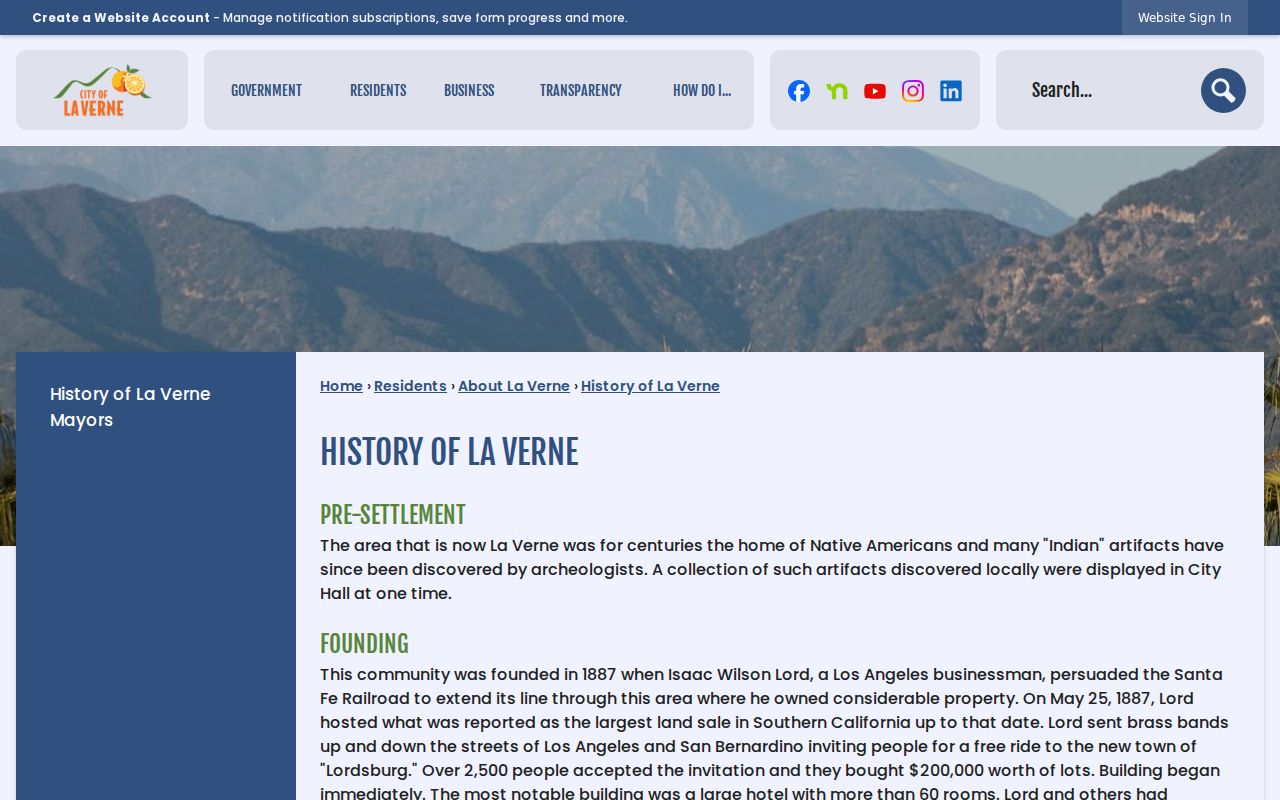
Place-name continuity is a search method here, not just background history.
Note: Run Lordsburg and La Verne as separate search terms before deciding that a family is missing.
Search La Verne's LAPL City Directories
The Los Angeles Public Library city and street directories collection covers a selected 1875 to 1987 range. Search by surname, given name, street address, Lordsburg, La Verne, and nearby Pomona. A regional collection can include the place in one edition and omit it in another, so open the title page and front matter before treating a result as local.
OCR saves time, but it is not authoritative. Broken words, initials, old type, and abbreviation marks can produce a false negative. When a search hit looks promising, browse the page image, capture the volume title, publisher, year, and area statement, and copy the entry exactly. The street-address portion can reverse the normal name search.
Telephone books follow another convention. They may show a subscriber, number, and address without listing a spouse or every person in the home. A city directory entry has the same basic limitation.
La Verne's Pomona-Area City Directories
Pomona Public Library's official Directories collection contains the clearest verified local sequence. The relevant volumes run irregularly from 1896 through 1951. Lordsburg appears in the twenty-volume set, while a La Verne query returns seventeen volumes with OCR-era incidental hits before the formal 1917 name change.
Verified publisher details include Edw. F. Parker for 1909, Los Angeles City Directory Co. for 1911, 1914, and the inspected 1919 to 1951 volumes, and T. M. Doyle for 1916. The 1903 API record has no publisher metadata. These are Pomona-area books, not proof of an annual La Verne-only series.
Use the official collection search, then inspect the scan. The exact Lordsburg API query is useful for discovery, but OCR can confuse h, l, initials, and broken words.
For a past address, record the edition, page, entry spelling, street line, and whether the item sits in an alphabetical or street section. That small citation makes a later household comparison possible.
Read a La Verne City Directory Entry
A typical city directory entry is compact. It may list a surname, given name or initial, spouse in parentheses, widow notation, occupation, residence, business address, telephone, and a tenure mark if that volume defines one. A street-address or criss-cross section reverses the key and lists a street, number, and occupant or subscriber.
| Name line | Surname, given name or initial, and sometimes a spouse in parentheses. |
|---|---|
| Occupation | A trade, role, or school connection as printed in that edition. |
| Residence | House number and street, sometimes with h or r notation. |
| Widow notation | A mark such as wid plus a spouse name, useful for family chronology. |
| Street section | Street heading, number sequence, occupant or business, and vacancy or new-house notes when present. |
- Criss-cross directory
- The street-order part of a directory, used to move from an address to a listed person.
- Householder index
- A name or address finding aid that may point to a primary listed person, not every resident.
- Abbreviation key
- The volume's own glossary. Photograph it before interpreting marks such as h, r, or wid.
- Subscriber
- The person or organization listed for a phone or address, not automatically the full household.
One verified Pomona scan shows a 1937-38 classified entry under Plumbers and La Verne, with a name and street address. A 1951 alphabetical example uses an occupation and an h or r mark. A 1934 entry includes a spouse, occupation, and a La Verne road address. These examples show field shape, not current contact information.
Trace a La Verne City Directory Household
Directory tracing works best when the target begins with a known year and a known address from a deed, census, obituary, or family paper. Search the surname with initials and spelling variants. Then check the same address in the street section. A first appearance and first absence bracket a change, but neither proves the exact move date.
- Open the edition and record its title page, year, publisher, and geographic coverage.
- Search the alphabetical section for the surname, spouse, initials, occupation, and address.
- Check the street section for the same number and note other listed entries.
- Move forward one edition at a time, then pair the directory with a federal census year.
- Use newspapers, probate, cemetery records, or a later deed to explain a departure.
The public census currently reaches through 1950 under the 72-year rule. Census records add age, birthplace, relationship, and occupation on enumeration day. A city directory can fill the years between decennial snapshots, while a deed supplies title rather than household membership. The official Census QuickFacts page helps anchor the place-name and population context before a historical search.
When the name disappears, test three explanations: a move, a death, or a directory omission. The La Verne Leader and family archives can distinguish them.
La Verne Wilson Library Archive Records
Wilson Library Archives and Special Collections preserves three overlapping collecting spheres: the University of La Verne, the city of La Verne, and the Church of the Brethren in Southern California. That combination can surface a family or affiliation that never appears in a county index. Yearbooks, alumni publications, photographs, correspondence, family papers, and congregational material may give a name, date, place, or relationship for historical research.
The city directory question should go to the archive staff as a collection request. Ask for finding aids, date ranges, access conditions, and reproduction rules. The official Wilson Library archive brochure gives collection and service context. Do not assume that a mention of an alumni or church collection means a current membership list is available. Historic material and present private contact data are different categories.
La Verne's public park directory shows the value of separating community context from resident identity. It contains park contacts and unit totals, not resident names.
The captured La Verne community directory illustrates that public local directories can describe a place without exposing household rows.
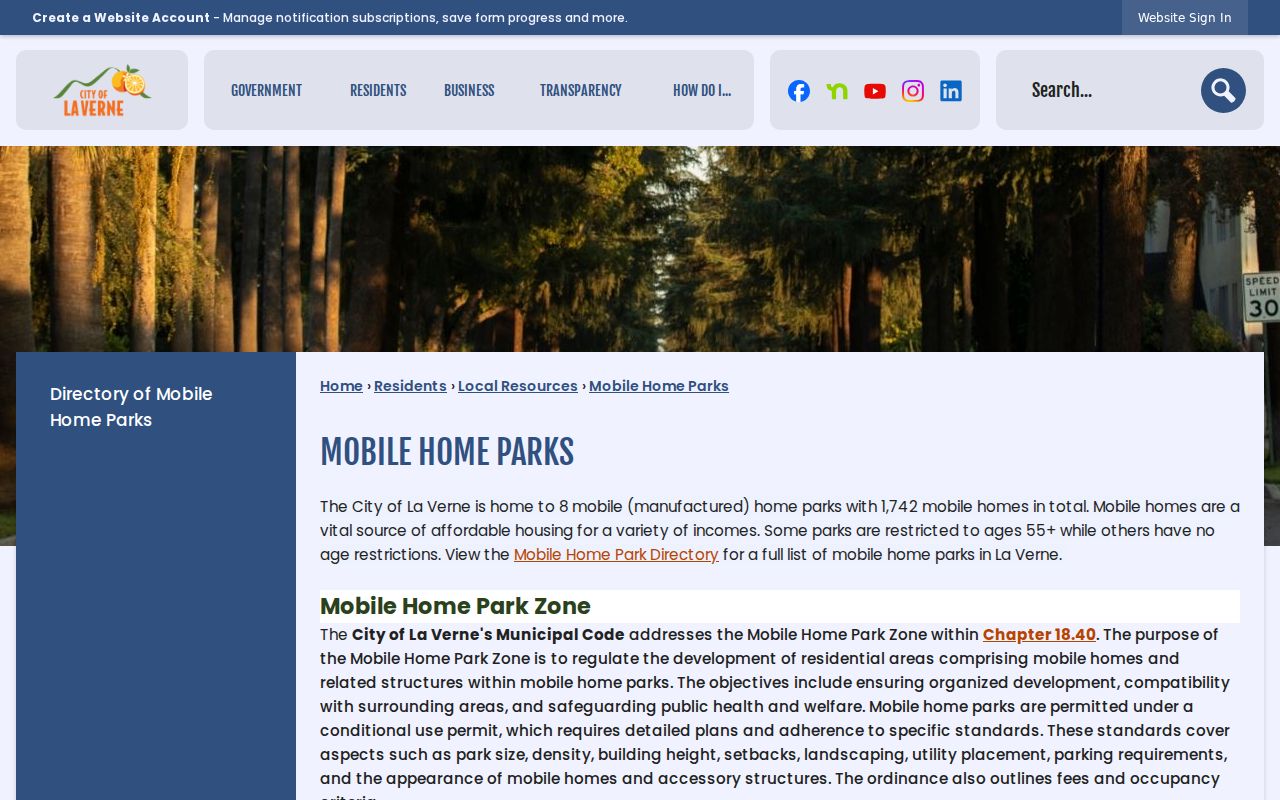
That boundary is useful when deciding whether an archive request is about history, a public contact, or private membership.
La Verne Leader Directory Clues
Wilson Library's NewspaperArchive access includes the La Verne Leader and highlights obituaries, marriage and birth notices, genealogy material, and photographs. Search exact phrases for a street or school, then try surname variants and Lordsburg. A social notice can identify a spouse, relative, club, or move that a directory only hints at.
The public page does not state the exact issue run. Ask the library or Archives and Special Collections about appointments, database access, and reproduction. Pair a notice with the original page image, a directory year, and a known address before treating it as a match.
A newspaper is strongest at the edges of a timeline. An obituary can explain why a directory entry ends. A birth or marriage notice can identify a family link. A property story can connect a name to a parcel without making that person a confirmed occupant.
La Verne County Records Around Directories
Historical directories do not answer every life-event question. The Los Angeles County Registrar-Recorder/County Clerk supplies marriage licenses, copies, fictitious business names, notary filings, UCC material, and county vital services. The Superior Court, not the Recorder/County Clerk, holds wills, probate, divorce, and case files. Use the record type to choose the office.
The county service gateway is useful when a directory entry needs a dated corroboration.
The captured RR/CC contact page shows the county office route for a historical records question.
Recorder and clerk services are separate from the historical shelf, but they can anchor a name to a date or event.
The county recorder services page gives the relevant county certificate and recorded-document gateway.
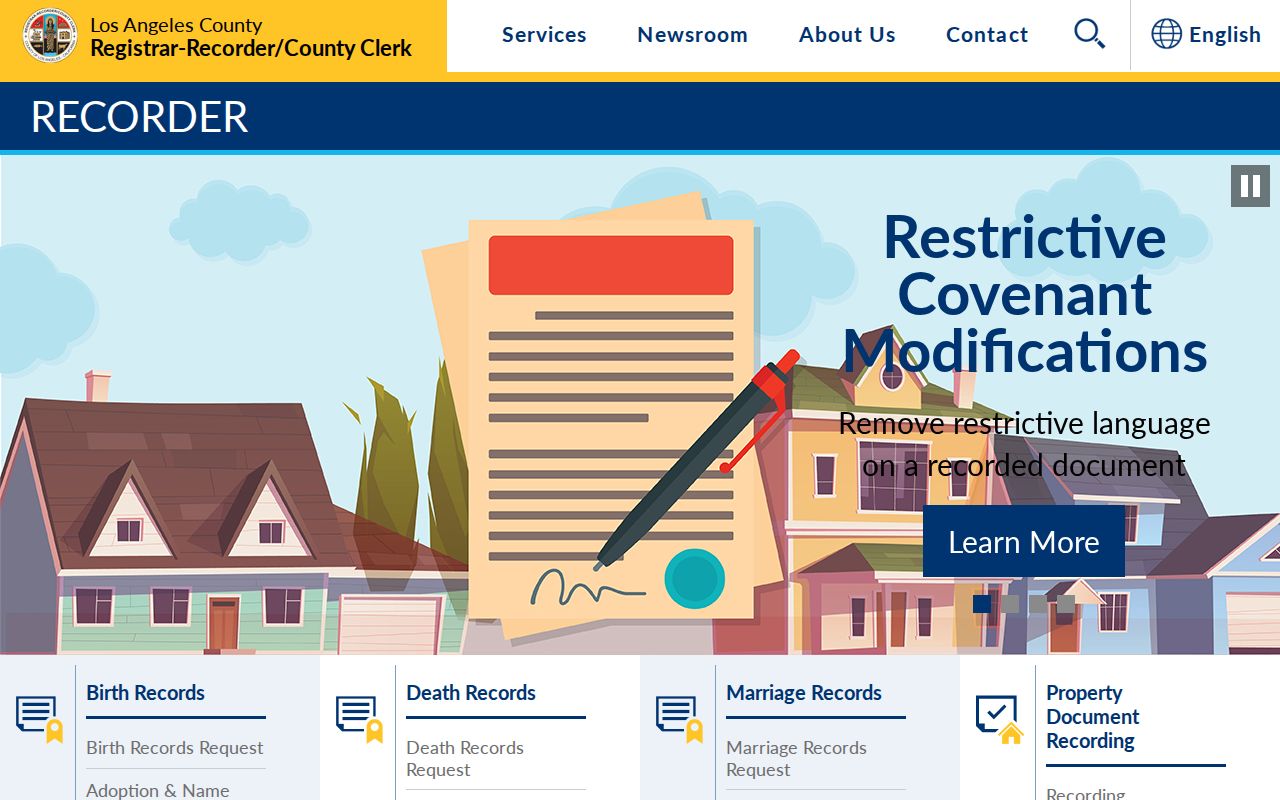
A county clerk service page supplies another official route for a public filing or copy request.
The captured county clerk services page keeps marriage, fictitious-business-name, notary, and related filing work separate from Superior Court case files.
Always record the custodian, record type, request date, and eligibility rule with the directory citation.
A Missing La Verne City Directory Entry
A missing name is not a clean negative. The person may have moved, died, used a different spelling, appeared under Lordsburg, lived outside the volume's geographic area, or simply not been listed. A street section may include a subscriber while the alphabetical section uses an initial. OCR may fail even when the scan is clear.
Check the title page, abbreviation key, adjacent editions, street section, census year, La Verne Leader, deed chronology, and archive collections. If the address moved through a parcel split or a street-label change, use the AIN and legal description rather than a guessed continuity.
When a directory find needs a present-day identity check, use the official records workflow on the resident lookup page linked in the navigation. When it needs a modern parcel chain, use the address tools on the By Street page.
Note: A city directory documents a published entry at a moment in time; it does not certify a person's current address.